Asif Ali Web & Digital Growth

Tour & travel · Paid search

The same trip, sold twice — at ₹299 and at ₹1,999.

Bus seats and private cars sit side by side in one catalogue. The moment both are advertised from one account they start competing for the same search — and the cheaper one always wins a click it should never have been shown.

Client
Bharat Incredible Tourism
Sector
Bus & car tours
Location
Panchkuian Road, New Delhi
Live site
bharatincredibletourism.com
01

The brief

Bharat Incredible Tourism sells the same destinations two ways. Delhi sightseeing is ₹299 on a shared bus or ₹1,999 in a private car. Delhi to Agra is ₹699 by bus or ₹6,499 by car. Jaipur, Haridwar and Rishikesh, and Kurukshetra are car packages at ₹6,499 to ₹6,999, and there are multi-day Chardham packages on top.

Those are not two prices for one product. They are two products with two entirely different buyers — a solo traveller near Paharganj counting rupees, and a family that wants a car to itself and will not share a coach at any price. Both of them type almost exactly the same words into Google.

  • Two buyers, one vocabulary — “delhi to agra tour” means both a ₹699 seat and a ₹6,499 car
  • A twenty-times difference in booking value that the bidding has to respect
  • Chardham packages on a completely different, seasonal decision cycle
  • An advance payment on a ₹6,999 booking, which raises the bar on trust before anyone enquires
02

The approach

Bus and car were separated into their own campaigns, and then — the part most accounts skip — negatives were pointed in both directions. “Cab”, “taxi” and “private car” were excluded from the bus campaigns; “shared”, “seat”, “budget” and the low fares themselves were excluded from the car campaigns. Without that, the two halves of the business quietly bid each other up all month.

Budget then followed value rather than volume. The car campaigns carry a much higher cost-per-click ceiling for the simple reason that one car booking is worth roughly twenty bus seats. Judged on clicks the bus campaigns look like the winner every time; judged on rupees they are not.

Chardham was treated as a third thing entirely — a seasonal package with a long consideration window, where a direct-response push wastes money and remarketing does the work.

  • Two campaign trees. Bus and car separated completely, with their own budgets, bids and copy.
  • Cross-negatives in both directions. Each tier excludes the other’s language, so they stop cannibalising each other.
  • Bids set by booking value. A car click is allowed to cost far more, because it is worth far more.
  • Vehicle and price in the headline. The ad tells the searcher which tier this is before they spend a click finding out.
  • Chardham as a seasonal, remarketing-led campaign rather than a direct-response one.
  • Registration details surfaced on site. GSTIN and Udyam shown plainly, because an advance payment needs a reason to trust.
03

What shipped

  • Separate bus and car campaigns, each with route-level ad groups
  • Cross-negative keyword lists so the two tiers never compete for one query
  • Responsive search ads naming the vehicle and the fare in the headline
  • Landing pages showing both tiers priced side by side, so the choice is made on the page
  • A seasonal Chardham campaign structure with remarketing rather than a constant push
  • Call, WhatsApp and form conversions tracked and verified before launch
  • Trust signals placed above the enquiry point: registration details, fleet, inclusions
  • Enquiry routing that tells you which tier the enquiry came from
04

What changed

The two products stopped fighting. A budget-led search now lands on a bus page and a private-car search lands on a car page, each with the right price already visible, which means the click is either qualified or it never happened.

The wider lesson generalises well beyond travel: any business with a cheap tier and a premium tier is running two campaigns whether it admits it or not. Left in one campaign, the cheap tier absorbs the impressions because it wins the auction on price — and the profitable half of the business slowly stops being advertised at all.

Evidence

From the account.

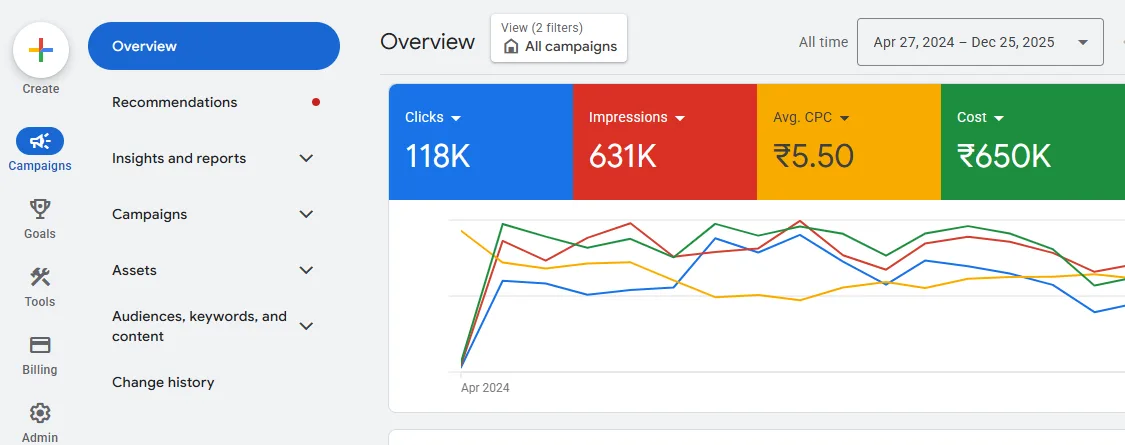
A screenshot taken straight from the Bharat Incredible Tourism campaigns. Click it to see it full size.

Google Ads account overview for Bharat Incredible Tourism covering 27 April 2024 to 25 December 2025: 118K clicks, 631K impressions, average CPC of 5.50 rupees and 650K rupees of spend
Google Ads overview — Apr 2024 to Dec 2025

This screenshot is from a live account, cropped only to remove client billing details. Nothing here is a mock-up.

More work

Other case studies.

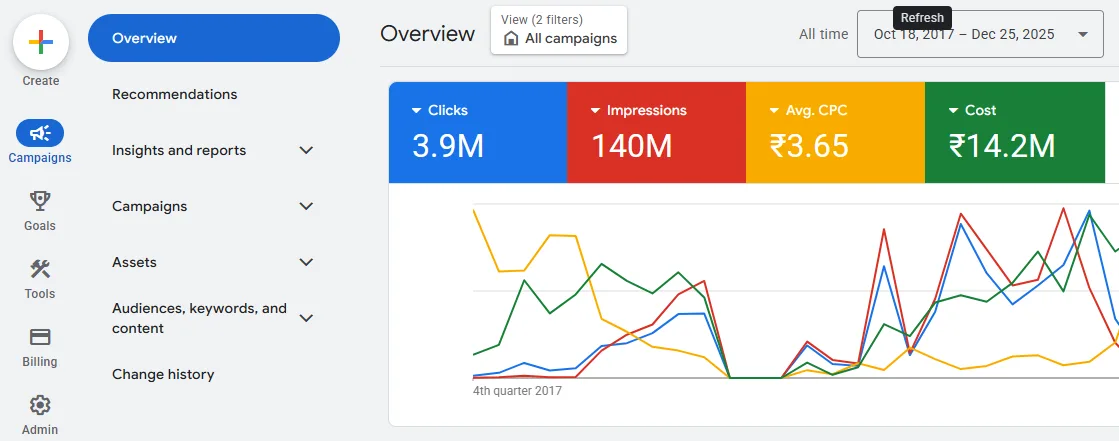
Google Ads account overview for India Tourism Incredible covering 18 October 2017 to 25 December 2025: 3.9M clicks, 140M impressions, average CPC of 3.65 rupees and 14.2M rupees of spend
Tour & Travel

India Tourism Incredible

Multani Dhanda, Paharganj, New Delhi

indiatourismincredible.com

Same-day bus tours out of Delhi, sold at ₹299 to ₹899 a seat. The whole account had to work at a price point where one wasted click matters.

Google AdsPPC ServicesWebsite DesigningSEO Services
Read the case study
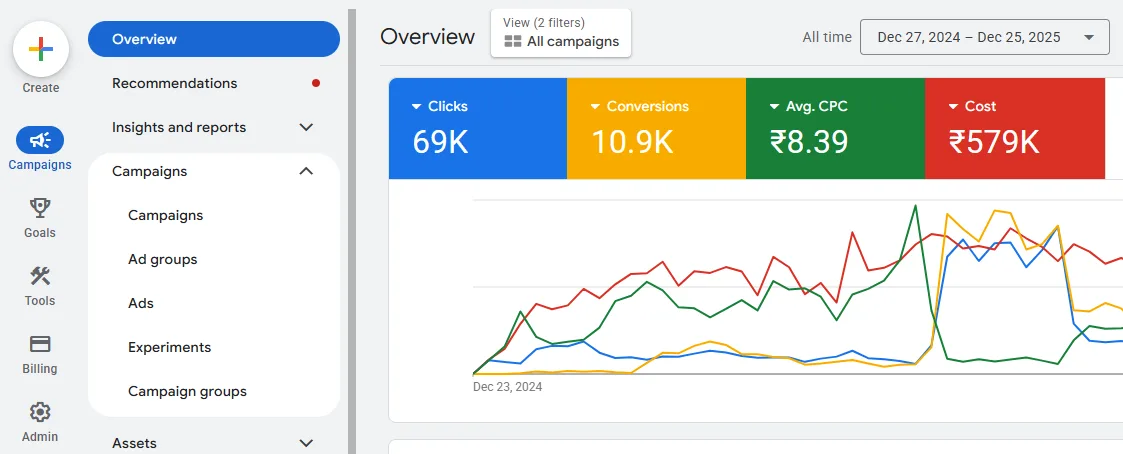
Google Ads account overview for Uppal Travels covering 27 December 2024 to 25 December 2025: 69K clicks, 10.9K conversions, average CPC of 8.39 rupees and 579K rupees of spend
Vehicle Rental

Uppal Travels

Opp. Paharganj Police Station, New Delhi

uppaltours.com

Tempo travellers from 9 to 26 seats. Nobody searches for “tempo traveller” — they search for the exact seat count their group needs, which makes the fleet the campaign structure.

Google AdsWebsite DesigningSEO ServicesLocal Promotion
Read the case study
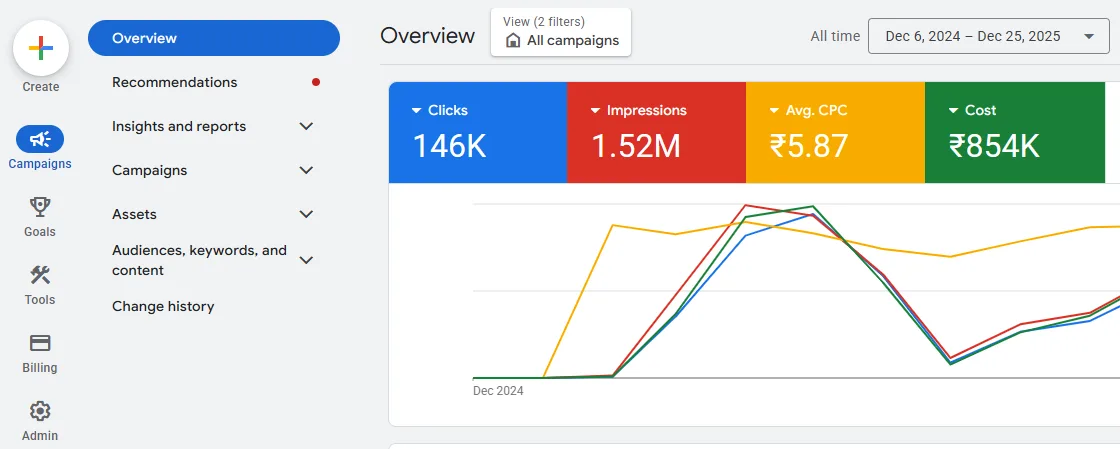
Google Ads account overview for Minto Holidays covering 6 December 2024 to 25 December 2025: 146K clicks, 1.52M impressions, average CPC of 5.87 rupees and 854K rupees of spend
Tour Operator

Minto Holidays

Janakpuri District Centre, New Delhi

mintoholidays.com

Hundreds of packages across twelve Indian regions and six countries, sorted six ways by theme. A catalogue that size cannot be advertised — only the right slice of it can.

Google AdsMeta AdsPPC ServicesLead Generation
Read the case study
Logistics & Transport

Big Wheels Logistics

Nawada, New Delhi · branch in Jaipur

bigwheelslogistics.in

A heavy-haulage operator whose enquiries arrived by phone alone. The site had to explain over-dimensional cargo to a procurement manager and get a quote request out of them.

Website DesigningWeb DevelopmentSEO Services
Read the case study
Healthcare & Diagnostics

Joshi Diagnostic Centre

Uttam Nagar, New Delhi

joshidiagnosticcentre.com

A neighbourhood pathology and radiology centre competing with national lab chains on the same search results page — and winning on proximity, price transparency and a phone call.

Website DesigningSEO ServicesLocal Promotion
Read the case study

Free consultation · No obligation

Running a cheap tier and a premium tier?

If both are advertised from one account without cross-negatives, the cheap one is eating the budget and the profitable one is going quiet. It is a structural problem, and it has a structural fix.

  • Campaigns separated by buyer, not by product name
  • Cross-negatives so your own tiers stop competing
  • Bids that follow booking value, not click volume
  • Fixed monthly fee — never a percentage of your spend
Start here

Send your enquiry

Name, number, email, what you need.

Same-day reply No obligation Details stay private

Call Now