You cannot advertise a catalogue. Only a slice of it.
Twelve Indian regions, six countries, and six ways of sorting the same packages. Hundreds of pages, one budget, and a decision that has to be made before a single campaign is built — which slice earns the spend.
Minto Holidays sells across Himachal, Rajasthan, Kashmir, Kerala, the
Golden Triangle, Goa, Uttarakhand, the North East, Jim Corbett, Tamil
Nadu, Maharashtra and Chardham inside India, and Thailand, Indonesia,
Dubai, the Maldives, Singapore with Malaysia, and Vietnam outside it. The
same packages are also sorted by theme — honeymoon, leisure, trekking,
adventure, hill station and religious — alongside fixed departures.
A catalogue that size is a genuine advertising problem, not an advantage.
Spread a budget evenly across it and every campaign is underfunded. And
the booking values are not comparable: a weekend hill-station trip and a
Maldives honeymoon differ by more than an order of magnitude, so treating
them as equally worth a click quietly funds the wrong half of the business.
Hundreds of packages, one budget — spread evenly, nothing gets enough spend to work
Booking values that differ by more than twenty times between categories
A consideration cycle measured in weeks, not minutes, so the first click almost never books
International and honeymoon demand that often does not exist as a search yet
02
The approach
The first decision was where not to spend. Search budget went to
the slice that carries the margin — honeymoon and international —
while the high-volume, low-value categories were left to organic search
and remarketing, which cost nothing per click.
Campaigns were then built on how people actually search, which is theme
crossed with destination: “honeymoon package for Maldives from
Delhi”, not “international tour”. That cross does not
match the website’s own menu structure, and it should not have to
— the account follows the customer, not the org chart.
Meta Ads were doing something search fundamentally cannot. A Maldives
honeymoon is an idea before it is a query; nobody searches for it until
somebody has planted it. Interest and life-event targeting creates that
demand, and search then captures it a few weeks later — which is also
why attribution here has to look at the whole path rather than the last
click.
At this ticket size the conversion is a conversation, not a checkout. The
funnel was built to open a WhatsApp thread, which is how this business
already talks to its customers, and remarketing kept the brand in front of
people through a comparison period that runs for weeks.
Budget concentrated by margin, not spread across the catalogue — honeymoon and international first.
Campaigns built on theme × destination, matching the query pattern rather than the site menu.
Meta Ads for demand creation, using interests and life events to reach people before they search.
Remarketing across both platforms, because a three-week comparison window is where most operators lose the booking.
WhatsApp-first enquiry routing, matching how the business already handles its customers.
Volume categories left to organic, so they still earn traffic without competing for paid budget.
A seasonal budget calendar, because hill stations, Chardham and international peaks do not share a season.
03
What shipped
Search campaigns on the theme-and-destination combinations that carry booking value
Meta prospecting campaigns built on life events and travel interests
Remarketing across Google and Meta for the full comparison window
WhatsApp-first enquiry routing, with the thread opened from the ad where possible
Lead tracking labelled by package category, so spend can follow what books
A seasonal calendar moving budget between domestic, religious and international peaks
Conversion tracking installed and verified before any campaign went live
Full admin access to every ad account, in the client’s name
04
What changed
The budget stopped being spread thinly across a catalogue and started
concentrating where a booking is actually worth something. Categories that
looked healthy on click volume and poor on revenue were moved off paid
search entirely — not switched off, just funded the cheaper way.
The honest caveat on a business like this is attribution. When Meta creates
the demand and search captures it three weeks later, a last-click report
will always credit search and always undervalue Meta. Any operator who
optimises purely on last click will eventually switch off the campaign that
was generating the demand — and then wonder why search volume fell too.
The traveller, tour and review counts shown on the live site are Minto
Holidays’ own figures. No performance claims are made on this page —
see the site.
— Evidence
From the account.
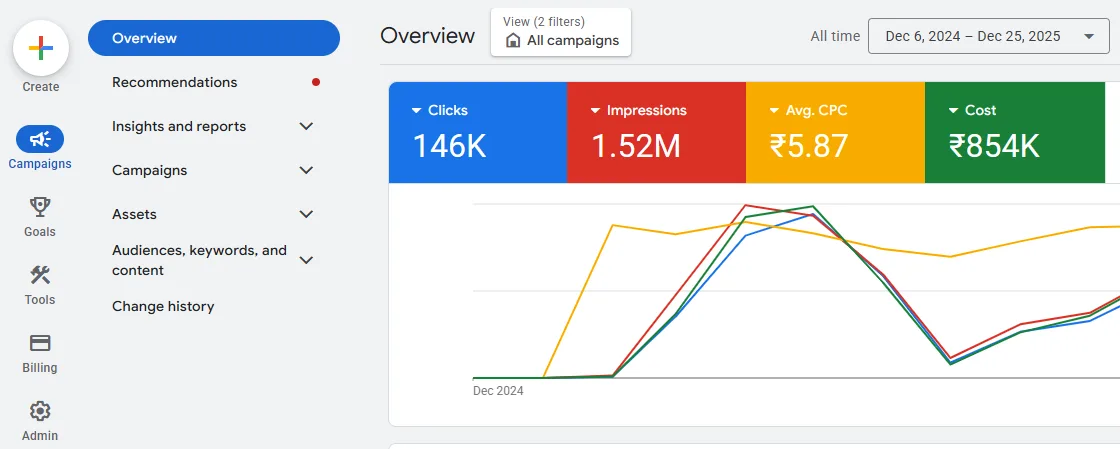
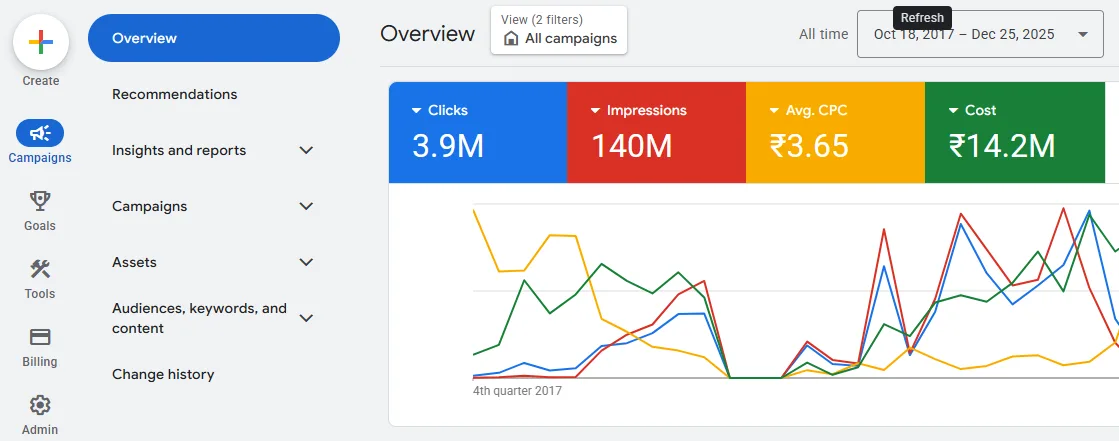
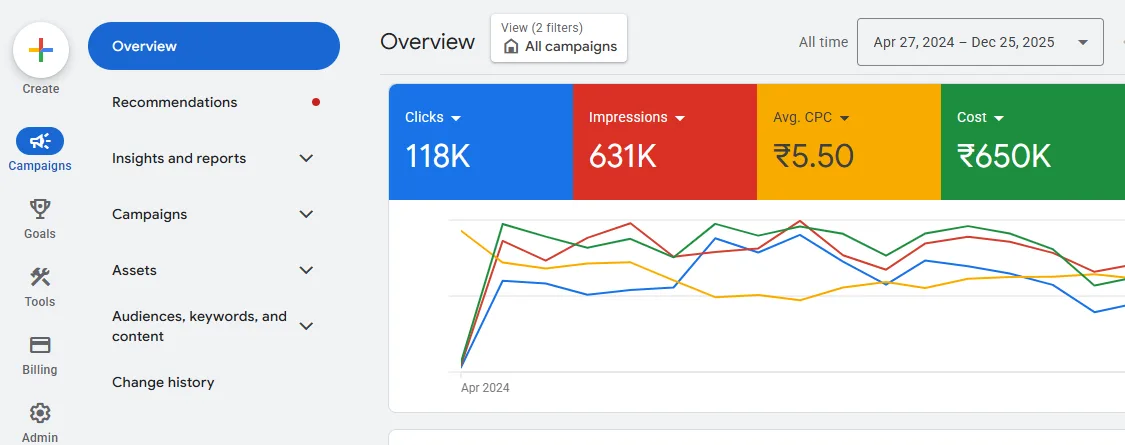
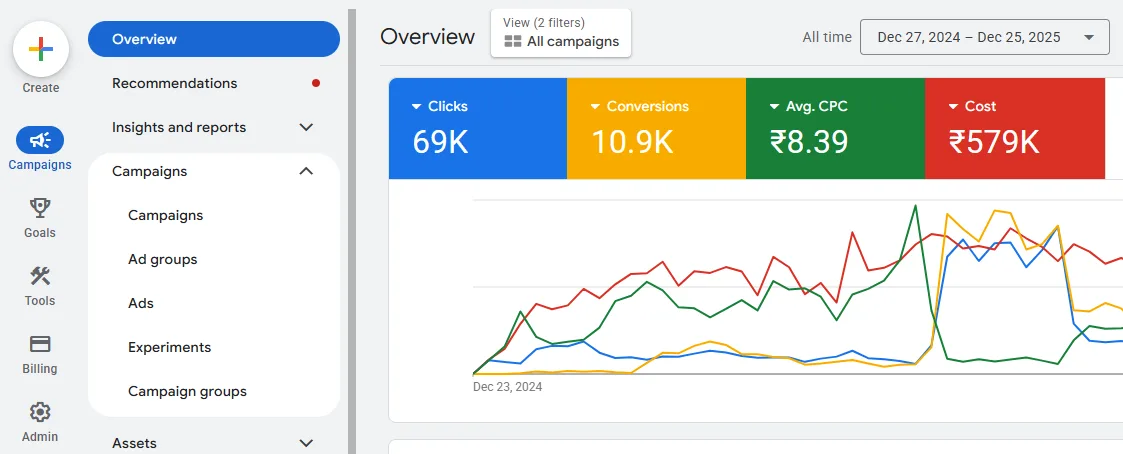
A screenshot taken straight from the Minto Holidays campaigns.
Click it to see it full size.
Google Ads overview — Dec 2024 to Dec 2025
This screenshot is from a live account, cropped only to remove client billing details.
Nothing here is a mock-up.
The same trips sold twice — ₹299 on a shared bus or ₹1,999 in a private car. Two buyers, two budgets, and one account that had to stop them bidding against each other.
Google AdsPPC ServicesWebsite DesigningLead Generation
Tempo travellers from 9 to 26 seats. Nobody searches for “tempo traveller” — they search for the exact seat count their group needs, which makes the fleet the campaign structure.
Google AdsWebsite DesigningSEO ServicesLocal Promotion
A heavy-haulage operator whose enquiries arrived by phone alone. The site had to explain over-dimensional cargo to a procurement manager and get a quote request out of them.
A neighbourhood pathology and radiology centre competing with national lab chains on the same search results page — and winning on proximity, price transparency and a phone call.
A large catalogue is an advertising problem before it is an advantage. The work is deciding which slice earns paid spend, which slice earns organic, and which channel creates demand rather than capturing it.
Budget concentrated where the margin actually is
Search and social doing different jobs, not the same one
Remarketing sized to a real comparison window
Reporting that does not judge everything on last click