Nobody rents “a tempo traveller”. They rent twelve seats.
The fleet runs from 9 seats to 26. Every one of those numbers is its own search, its own price and its own customer — which makes the fleet list the campaign structure, not just a page on the website.
Uppal Travels rents tempo travellers out of Delhi — 9, 12, 14, 16, 18,
20 and 26 seaters, plus the Urbania 12-seater — for routes across
North India: Manali, Shimla, Dharamshala and Mussoorie in the hills,
Agra and Jaipur on the Golden Triangle, and the pilgrimage circuit
through Haridwar, Rishikesh, Vrindavan, Varanasi, Ayodhya, Khatu Shyam,
Katra and Chardham.
The person booking is almost never the person travelling alone. It is an
organiser — a family elder, an office administrator, a group leader
— who already knows exactly how many people are coming. They do not
search for a category. They search for a number.
The search unit is the seat count, and so is the price — a 12-seater and a 26-seater are different products
A second axis on top: the destination, which changes the quote as much as the vehicle does
Quoted per vehicle, not per person, so the whole page has to speak to one organiser
Heavy competition from classifieds and resale listings on the same keywords
02
The approach
The account was built to mirror the fleet. One ad group per seat count,
because that is the unit of the search and the unit of the quote —
somebody typing “16 seater tempo traveller” has already made
a decision, and sending them to a general rental page throws that
decision away.
Across that runs the second axis: destination. For the routes with real
volume, seat count and destination cross into the queries that actually
convert — “16 seater tempo traveller for Manali” is a
booking, while “tempo traveller” on its own is a browse. The
Urbania was pulled out separately, since people search it by name the way
they search a brand.
Rental keywords attract a very specific kind of waste: people who want to
buy a tempo traveller, finance one, or find a driving job. Those
queries look identical to a rental query until you read them, and they
were excluded from the start rather than after a month of paying for them.
Underneath the ads, two slower channels. The Google Business Profile,
because “tempo traveller near me” is a map result before it is
a search result — and SEO on the same seat-count pages, so the queries
being paid for today start arriving free later.
Ad groups mirroring the fleet. 9, 12, 14, 16, 18, 20 and 26 seaters, each with its own copy and landing page.
Destination crossed over seat count for the high-volume routes, where the real booking intent sits.
Urbania treated as a brand search, kept out of the generic seat-count groups.
Purchase intent excluded early. Buy, sale, resale, EMI, loan, classifieds and driver-job queries negatived out.
Google Business Profile at the Paharganj address, because local rental searches resolve on the map first.
SEO built on the same pages, so paid and organic compound instead of duplicating each other.
03
What shipped
A page for every seat count in the fleet, priced and specified separately
Destination pages for the routes that carry genuine search volume
Search campaigns whose ad groups map one-to-one onto those pages
Negative keyword lists covering purchase, finance, resale and recruitment intent
Google Business Profile set up and aligned to the Paharganj location
Call-first page design — the number visible at every scroll position
Conversion tracking on calls, WhatsApp and enquiry forms
On-page SEO across the seat-count and destination pages
04
What changed
The query and the landing page finally match. An organiser who needs a
16-seater for Manali sees an ad about a 16-seater for Manali and lands on
a page about exactly that, with the number to call already on screen.
The structural insight is worth stating plainly, because it applies to
any rental business: the inventory is the campaign structure. Seat
counts, capacities, sizes and models are not attributes to be filtered on
a listing page — they are the words customers actually search, and an
account that ignores them is bidding on the browse instead of the booking.
The client figures shown on the live site — including “over 5,000
happy clients” — are Uppal Travels’ own. No ranking or traffic
claims are made here —
see the site.
— Evidence
From the account.
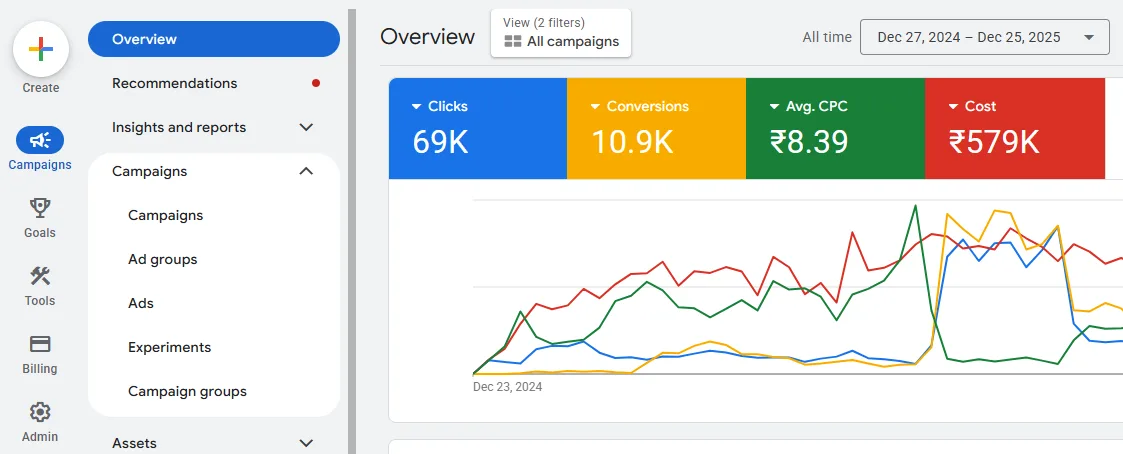
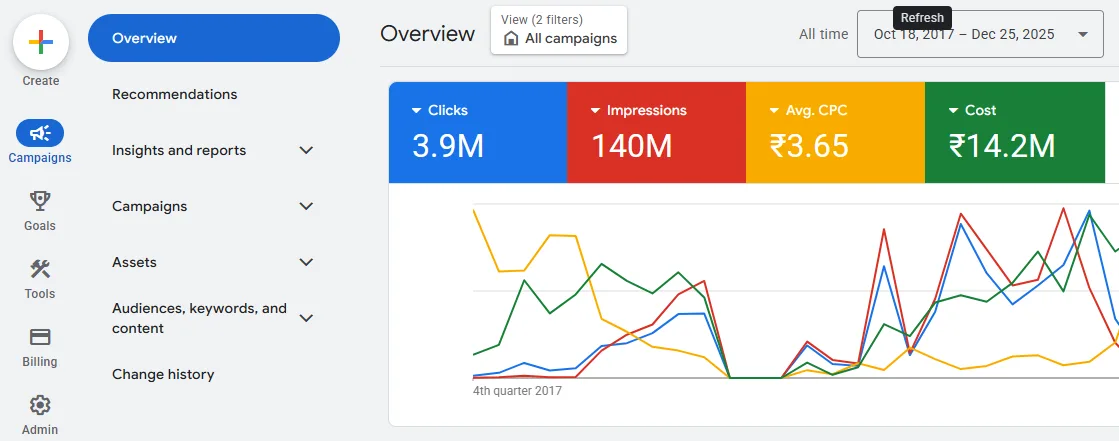
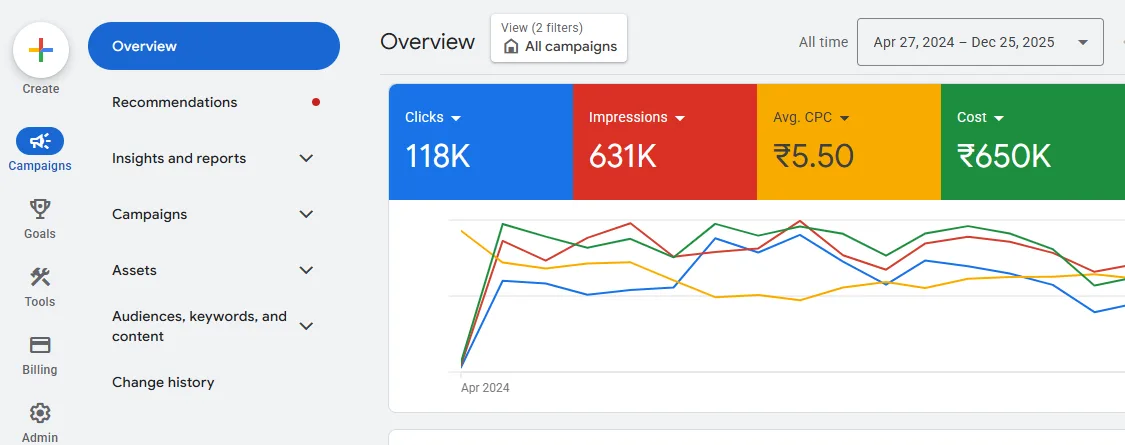
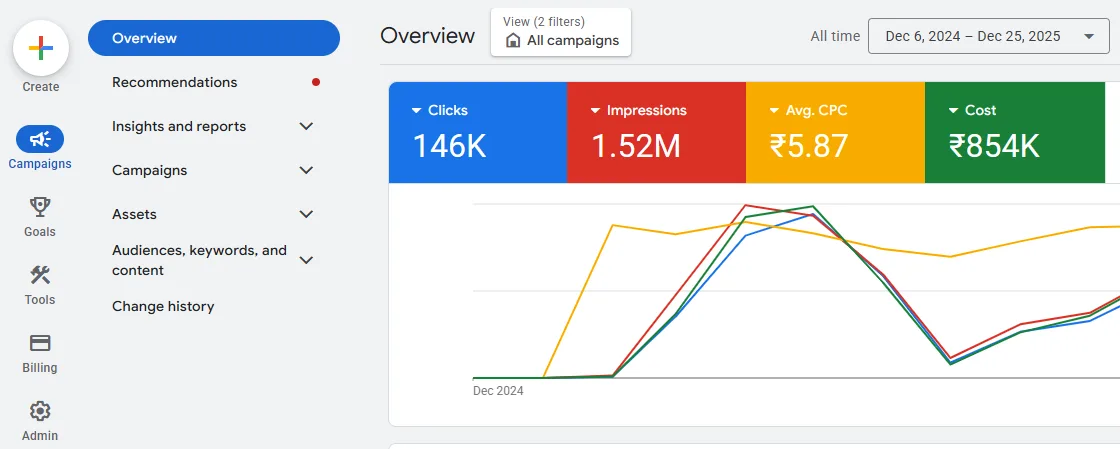
A screenshot taken straight from the Uppal Travels campaigns.
Click it to see it full size.
Google Ads overview — 69K clicks, 10.9K conversions
This screenshot is from a live account, cropped only to remove client billing details.
Nothing here is a mock-up.
The same trips sold twice — ₹299 on a shared bus or ₹1,999 in a private car. Two buyers, two budgets, and one account that had to stop them bidding against each other.
Google AdsPPC ServicesWebsite DesigningLead Generation
Hundreds of packages across twelve Indian regions and six countries, sorted six ways by theme. A catalogue that size cannot be advertised — only the right slice of it can.
A heavy-haulage operator whose enquiries arrived by phone alone. The site had to explain over-dimensional cargo to a procurement manager and get a quote request out of them.
A neighbourhood pathology and radiology centre competing with national lab chains on the same search results page — and winning on proximity, price transparency and a phone call.
Sizes, capacities, models, seat counts — if customers search them, they are ad groups and landing pages, not filters on a listing page. Most rental accounts are bidding on the browse and wondering why the phone is quiet.
Campaigns built from the words customers actually type
Purchase and recruitment traffic excluded from day one
Google Business Profile set up properly for near-me searches
SEO underneath, so paid traffic stops being the only traffic